Space Inquiry Camp, Starting from the Library in Taiwan
Taiwan × Japan Children's Architecture Education Program
We had no language in common. Even so, it began with pointing at the pages of a picture book—then measuring, walking, drawing, building—and it carried all the way to sixteen children presenting “their own library.” This is that path, told as a single story.
Record & text: Mutsumi Nakahira (née Nogami) / MIRAI CRAFT Architectural Design Office
Taiwan co-practitioners: Jason Wang (Wang Chai-Hsien) & Winnie Tseng (Tseng Hsien-Yun) / New Taipei Municipal Zhonggang Elementary School
January–July 2026 (April in Japan / July in Taiwan) | August 2026
ABOUT THIS PAGE
This is a visual retelling of a full 32-chapter practice report (August 2026), made for readers meeting the project for the first time. It draws faithfully on that report—the story of what happened, and the numbers, episodes, and ideas behind it. The complete scholarly discussion (theory, case studies, limitations) lives in the full report.
All children's names are anonymized. Photographs are published within the range permitted by the children's guardians.
STORY
It began with one message
On December 22, 2025, a message arrived on Instagram from an elementary school teacher in Taiwan. He had seen our activity of building domes out of newspaper: “It looks so professional, and wonderful.” The sender was Jason, a science teacher. His first idea was a science lesson—projecting a starry sky inside a dome—and it came with a candid confession: that as a teacher, he had not yet managed to draw children into the heart of architecture.
From there, we wrote almost every day. But in January 2026, the plan stumbled once. The idea of “building a star-dome,” with a finished object decided in advance, was questioned by the funding body: if the outcome is fixed from the start, the value of inquiry disappears. So the two of us rebuilt the plan from the ground up—into an open inquiry with no predetermined finished form. The principle that would later run through the whole three days—“one goal, one constraint; leave the rest to the children”—may well have grown out of this very lesson, which we, the teachers, had to learn first.
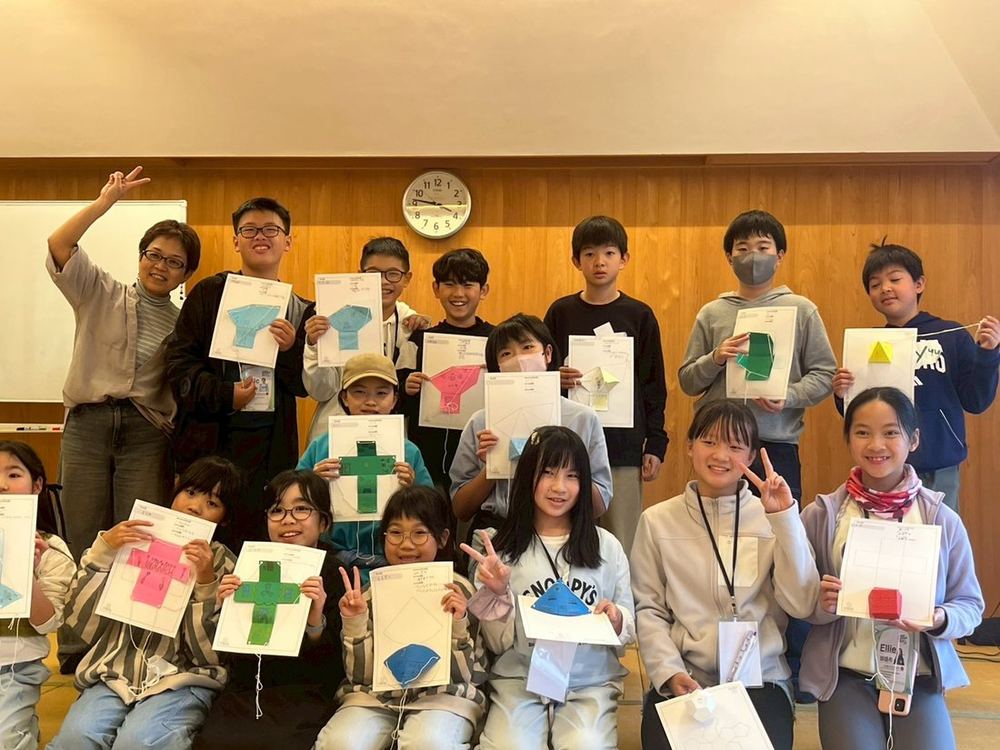
April, in Japan. Six children from Taiwan came to Kagawa and Naoshima. The night everyone raised a newspaper dome and slept inside it, the secret base became a real “home.”
2025.12.22
The first message, on Instagram
Jason found our newspaper-dome posts and reached out himself—with his star-dome idea and a candid confession.
2026.01
A stumble, and a redefinition
The “fixed outcome” plan stalled. Through dialogue, we reshaped it into an inquiry with no answer set in advance.
2026.3.31–4.4
Japan (Kagawa & Naoshima)Taiwanese children on the “can't-read” side
Six children from Taiwan and nine from Japan. Dialogic art viewing on Naoshima, architecture walks in Takamatsu, a newspaper dome, and a night together.
2026.6.8
Co-designing over Zoom
We organized the three-day plan around two axes—“knowledge to learn” and “how learning shows.” That format grew from Jason's proposal.
2026.7.1–3
Taiwan (Zhonggang Elem. & NTU)The instructor on the “can't-read” side
Three days with sixteen children. Observing, measuring, designing, building, and presenting “their own library.”
2026.7.24
An independent report arrives from Taiwan
Jason wrote a chapter from his own point of view (Part 7 of the full report)—an outside assessment, independent of my records.
2026.08
The full practice report is completed
Ten independent primary sources and the Taiwan chapter, cross-checked into 32 chapters. This page is its visual retelling.
RECORD
Three days in Taiwan, July 2026
We had no words in common. And still, not a single child dropped out.
The instructor is me, Mutsumi Nakahira. I speak no Chinese at all, and my English is below an elementary-schooler's. The children are Chinese speakers. With no spoken language in common, the three-day architecture program ran from July 1 to 3, 2026. And all sixteen children saw it through—from design to model-building to presenting in front of everyone.
The guardians' voices that came afterward were, every one we received, “very satisfied.” And that same “everyone” answered that not sharing a language turned out, in fact, to be a good experience.
This record is not written from impression. The in-class machine-translation exchanges were all kept with timestamps, and ten kinds of independently created sources—my records, the children's and guardians' surveys, photos, presentation videos—were cross-checked, with only what they agreed on written down as “confirmed.” Because this was a small program, the survey results are handled cautiously—not as “proof of effect,” but as a record that “no strong dissatisfaction appeared.”
NAME
Space Inquiry Camp, Starting from the Library
DATES
July 1 (Wed)–3 (Fri), 2026 9:00–16:00 each day
PLACES
New Taipei Municipal Zhonggang Elementary School (Days 1 & 3) / National Taiwan University (Day 2)
CHILDREN
16 (grades 3–6)
INSTRUCTOR
Mutsumi Nakahira (née Nogami) / MIRAI CRAFT Architectural Design Office. Speaks no Chinese
TEAM
Jason Wang (planning & overall), Winnie Tseng (interpreting), and others
PRELUDE
April 2026, in Japan (Kagawa & Naoshima). A sequel to that exchange, where six Taiwanese children visited
PATH 1 | July 1 · Zhonggang Elem.
To hear, to point
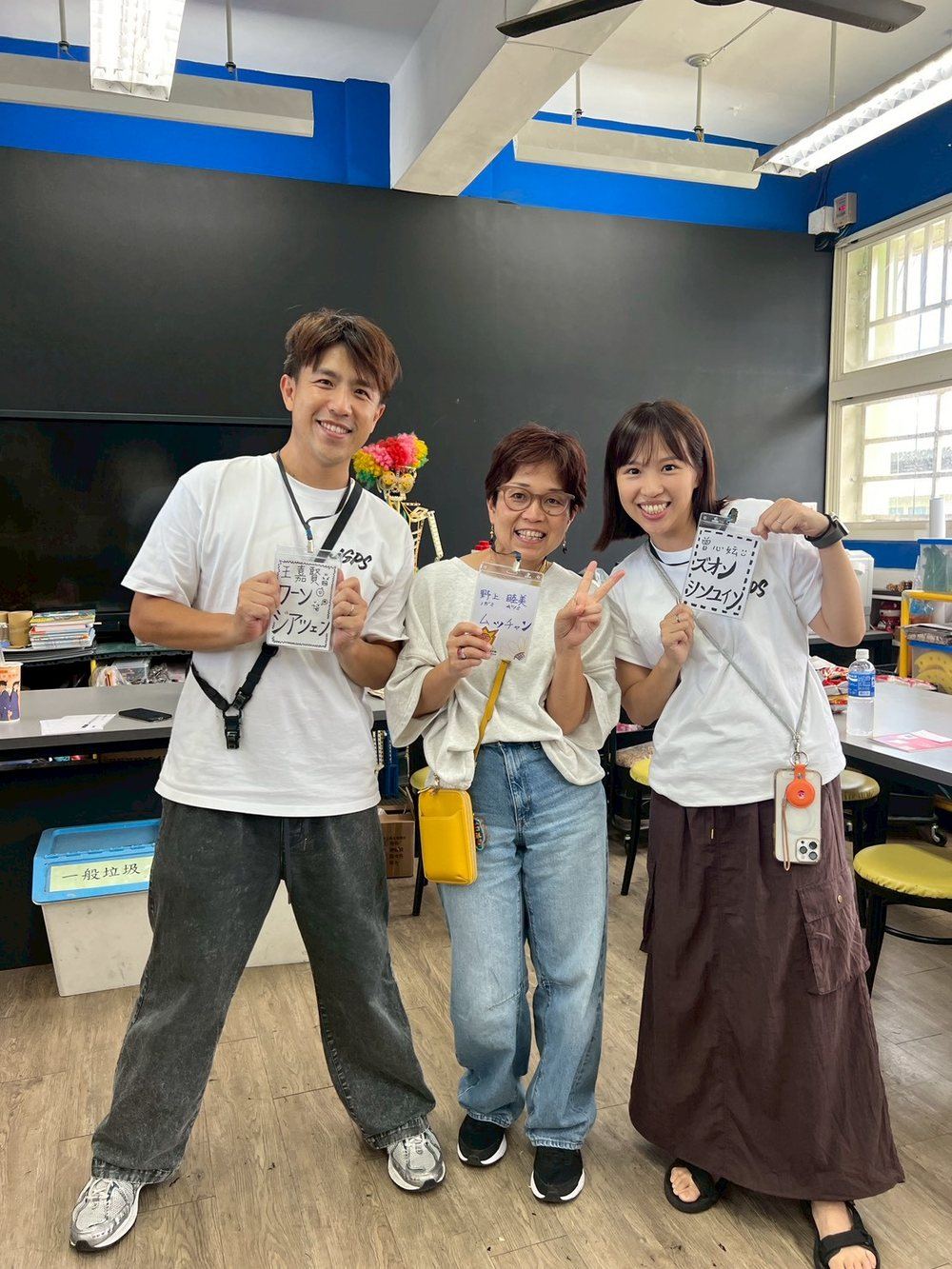
The three days began with a picture book—but first, name tags. We wrote each child's Chinese name alongside its katakana, and I made a name tag of my own too. Not as the one who teaches, but as one of the makers.
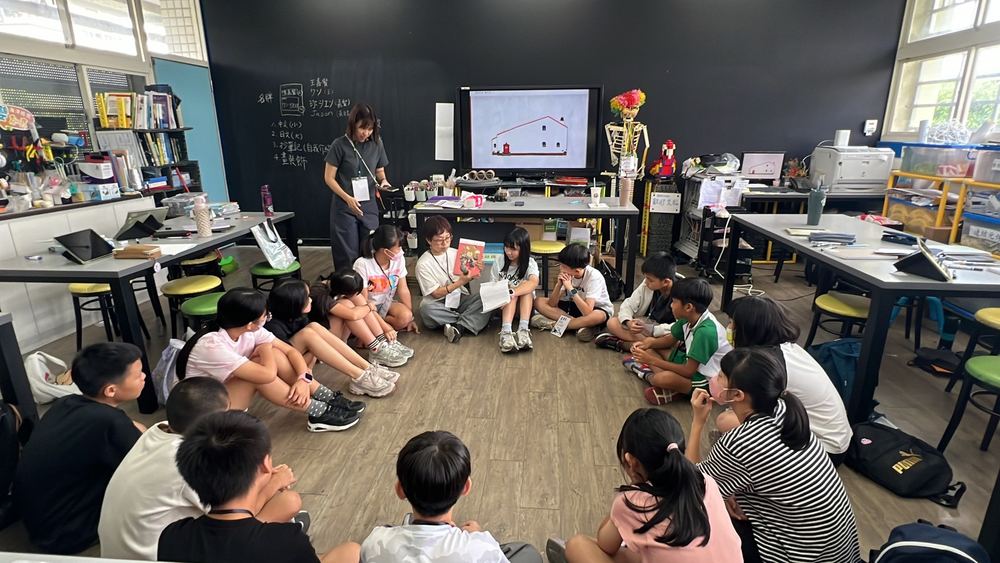
I read the picture book This Is Home in Japanese, and two children who had visited Japan in April read it back, taking turns, in Chinese. A moment when the children became the interpreters. When we finished—“Does the white dragon in the town really have nine tails?” “Where's the little fairy?”—everyone shared what they'd found by pointing.
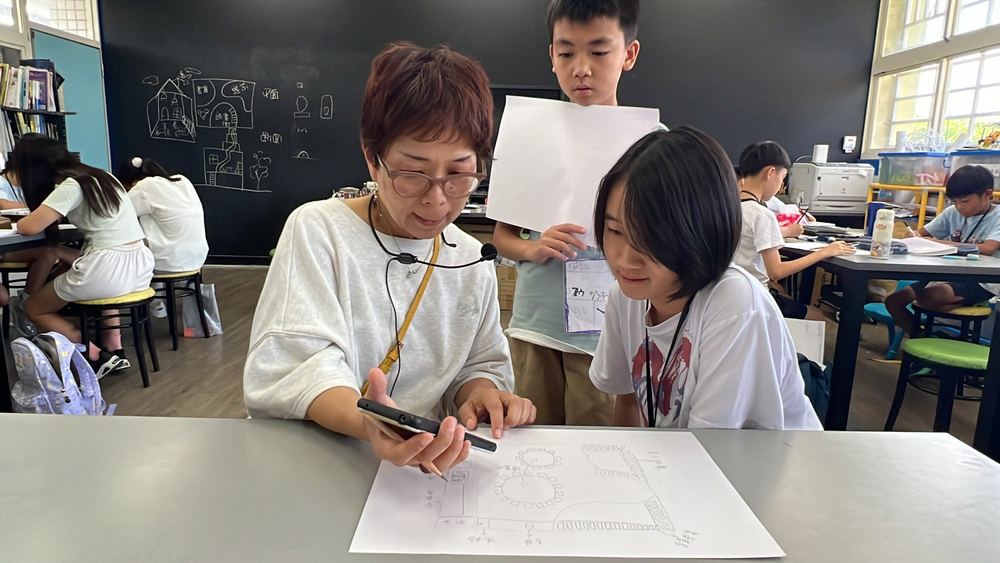
After the book, each child drew “a home just for me” as a cross-section. A house with a slide, a house that moves, a house with a field on the roof. “Spilling outside the frame is a very good thing,” I told them.
Making name tags. It was I who was taught—by the subtle differences between the katakana “n, so, shi, tsu.”The picture book This Is Home—in two voices, Japanese and Chinese.
FROM MY RECORDS
“Pointing needs almost no words. And yet, I can know what that child discovered.”—the first stone in the path that words can cross.
PATH 2 | July 1 · School library
To measure
In the afternoon, we moved to the school library. Counting the shelves and chairs, the children drew floor plans. To a child who had left out the chairs: “There are eight of these chairs, but you haven't drawn them—count again,” a check made right there.
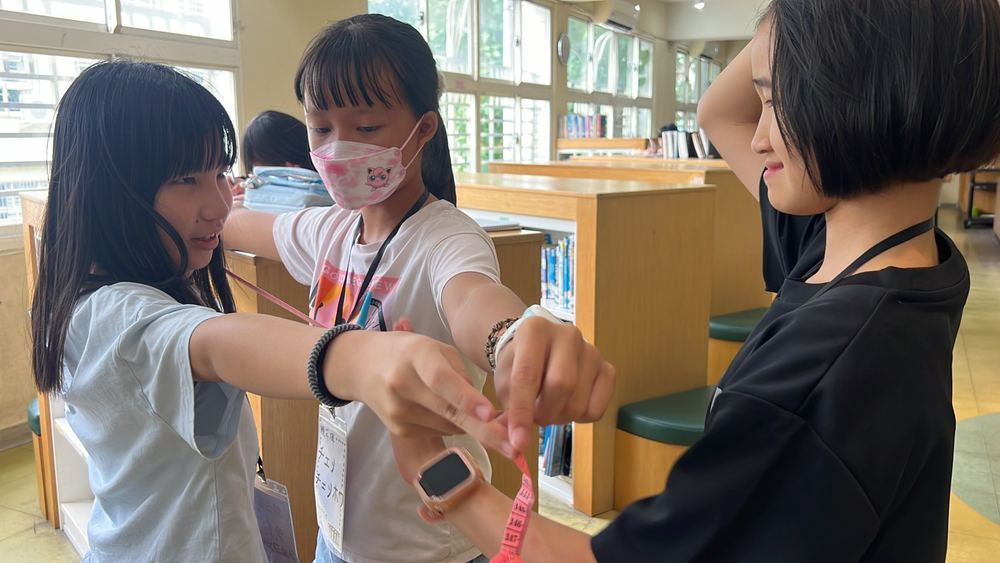
And then, before any tools, we measured with the body. The length of a finger, an arm, a height, the distance to a joint—each child measured and recorded their own. One child traced their hand and wrote in the measurement of every knuckle. Numbers are a common language—neither Japanese nor Chinese. From here, the “dialogue” between me and the children began to move in dimensions and ratios.
The last hour was for reading, freely. “To make a library, you first have to enjoy books.” Everyone chose their top three favorites and introduced them, holding up the covers.
“Turning feeling into numbers, and numbers back into feeling.”
PATH 3 | July 2 · National Taiwan University
To walk, to see
Day two: inside real architecture. The conversation about buildings had already begun on the bus. When I said “that bridge is interesting,” one child answered, “What Taiwan cares about most isn't function—it's being beautiful,” offering an architectural view of their own.
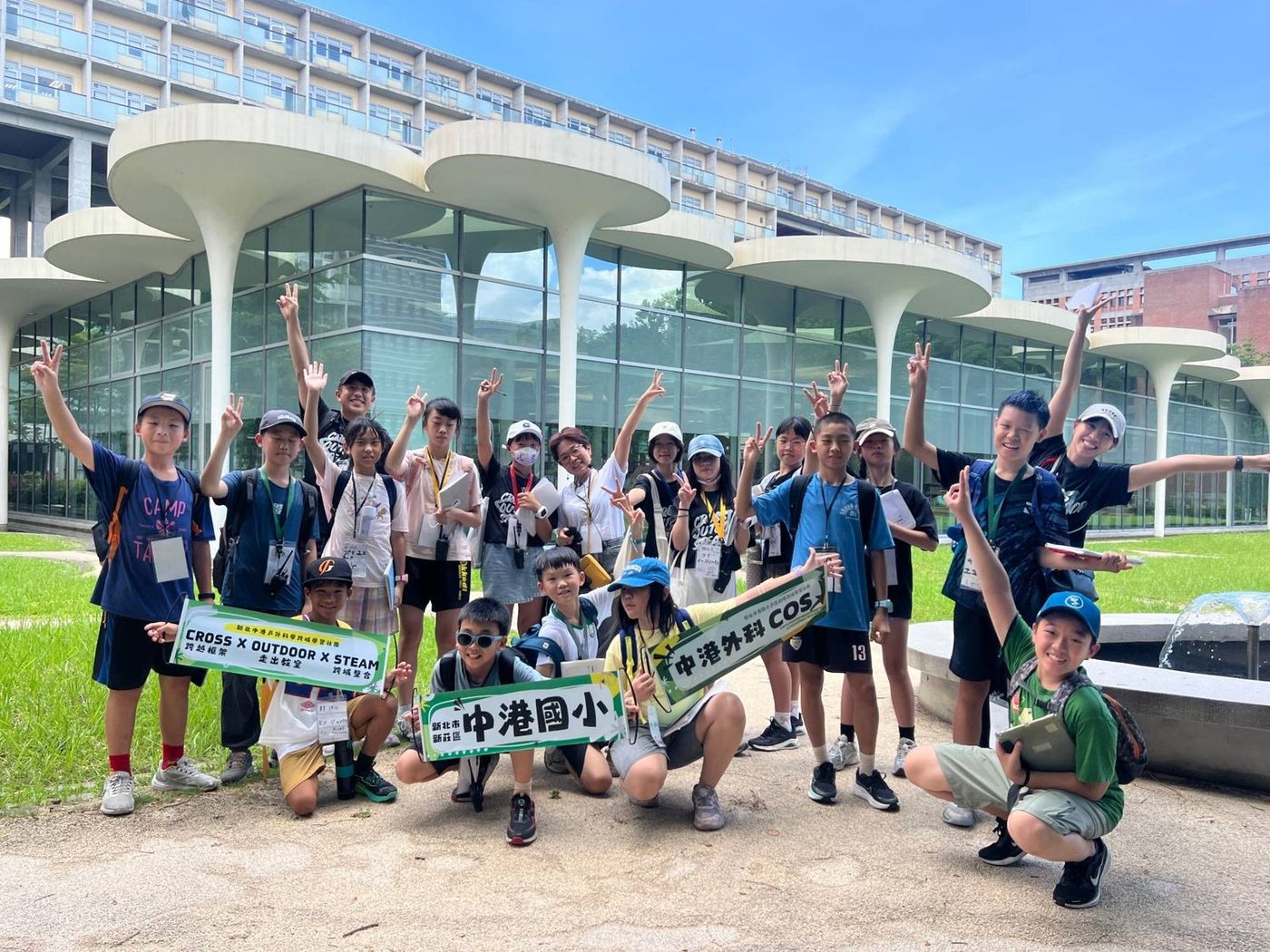
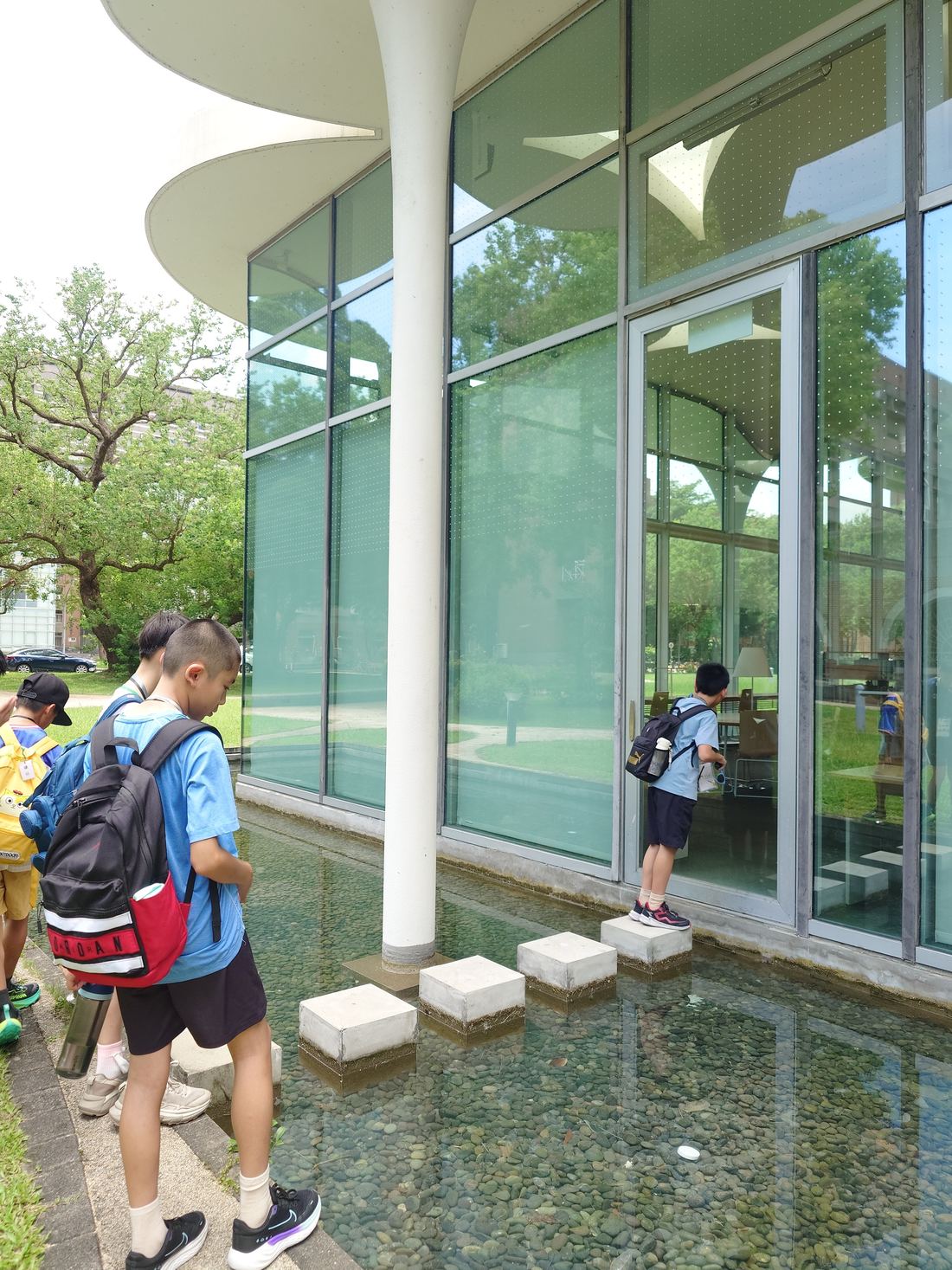
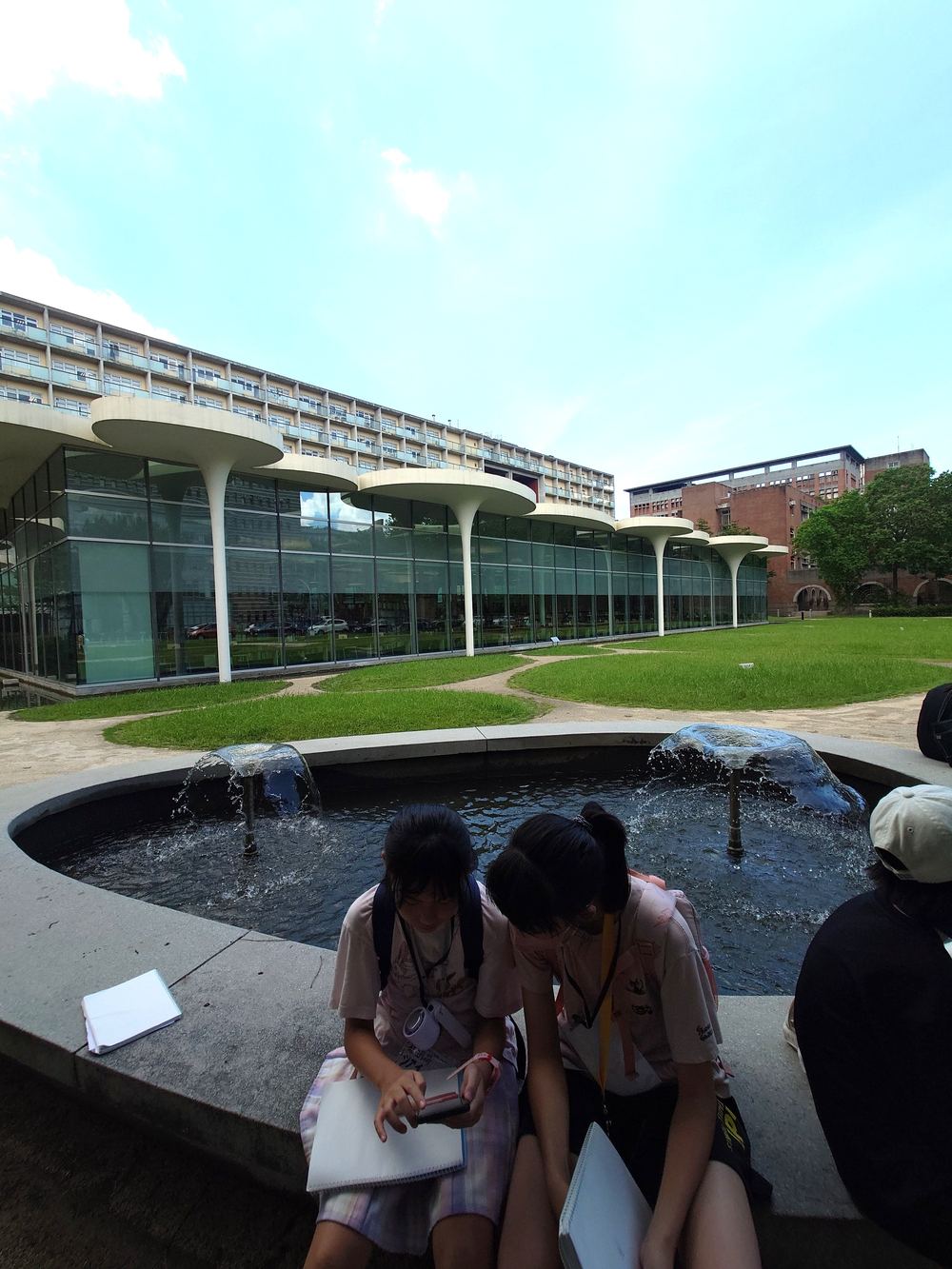
On campus, Jason handed the children a map and let them find the way themselves, “even if you get it wrong.” At Toyo Ito's library for the College of Social Sciences, we began by observing—“What does it look like?”—and the children searched out where the architect's intention, “to read a book as if in a forest,” appeared. They measured the height of a handrail (in Japan there's a rule: at least 110 cm) and the spacing of the lattice (11 cm), and we shared words like “stepping stones” and “waffle slab” on the spot. One child reasoned out a dimension they couldn't reach: “If I can't measure it here, I can't over there either—because the ratio is symmetrical.”
One child described the measuring under the blazing sun, back at home: “I had a mission, so I got absorbed and forgot the heat” (from the guardian survey).
Observation that starts from “What does it look like?”From what they saw, sketching what they liked—what caught their eye—to keep.
A MOMENT AT THE HALL OF UNIVERSITY HISTORY
In a high-ceilinged reading room, a child noticed a hole in a bench: “What's this?” I asked back, “What do you think it's for?” and received their guesses—“a place to put things,” “your own bag”—as “a fine idea.” The answer we checked, last, with the librarian (a slot to stand magazines and newspapers). “Many questions came up, but I answered not a single one.”
PATH 4 | July 2 evening → Day 3 morning
To draw
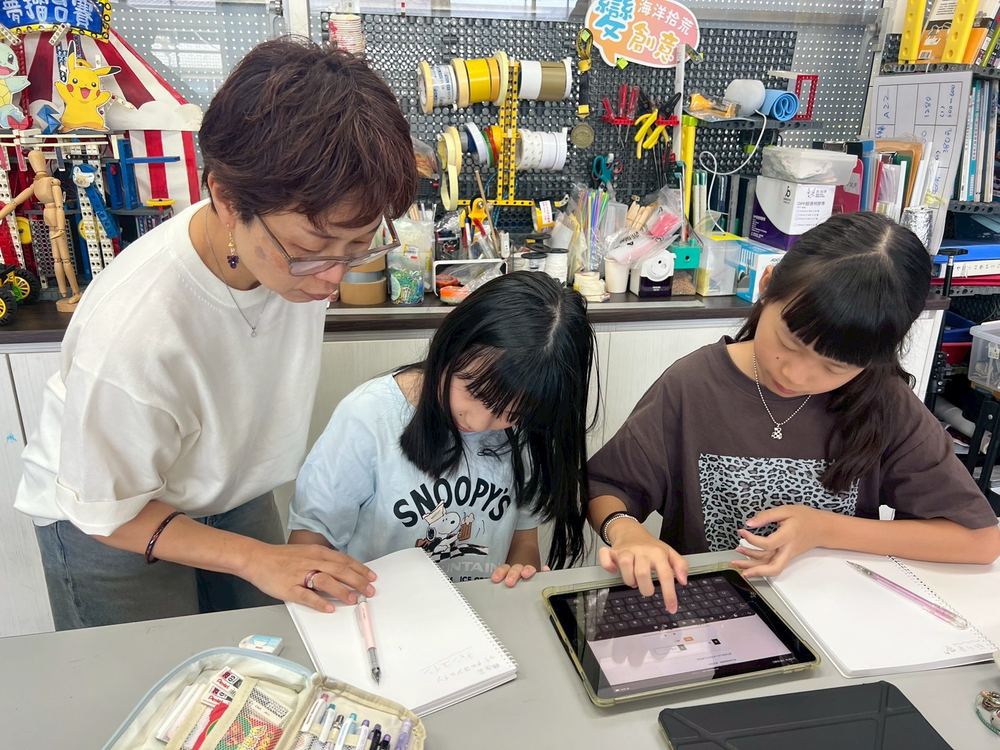
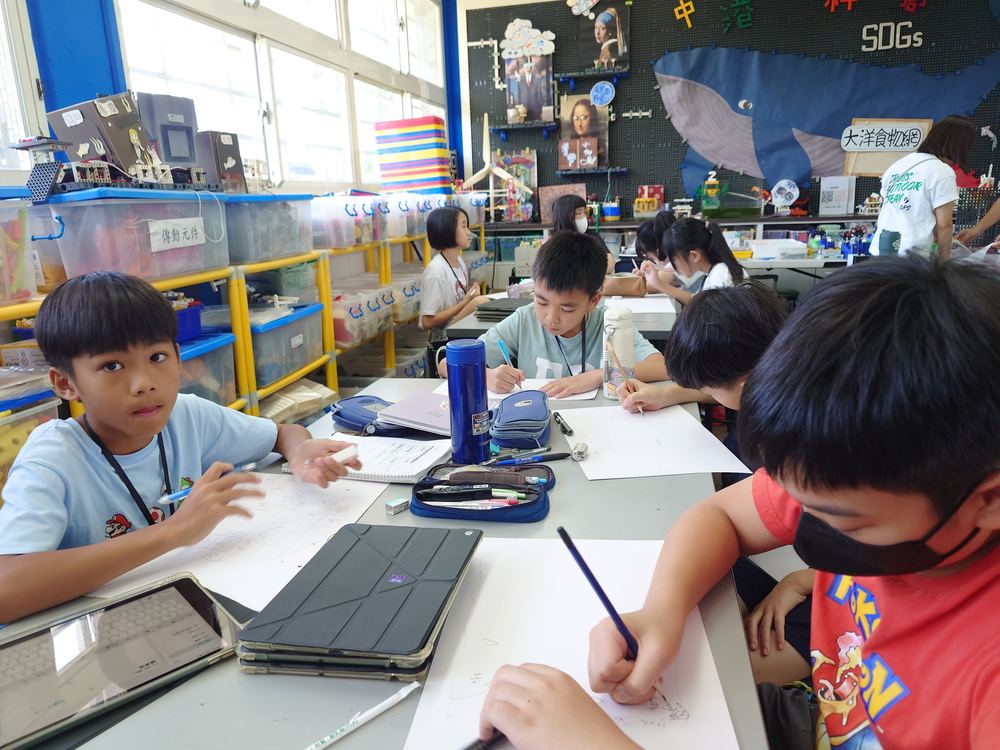
Back at school, the task was to draw the interior from memory. And here, something unexpected happened: many of the children started searching for images on their tablets. “They aren't used to drawing from memory, from imagination, from thought”—that realization led straight to the next day's decision.
On the morning of day three, I declared that tablets would not be used, and said why: “I don't want to pull ideas out of the internet—I want to pull them out of the imagination.” Then, to floor plans. When I drew a plan freehand, the children gathered around on their own to watch. Windows, doors, walls, all drawn freely, unbound from squares. “Who uses it” was free too—a library for animals, for squirrels, was fine.
Drawing from memory, from imagination, from thought.
PATH 5 | July 3 · Building the models
To build
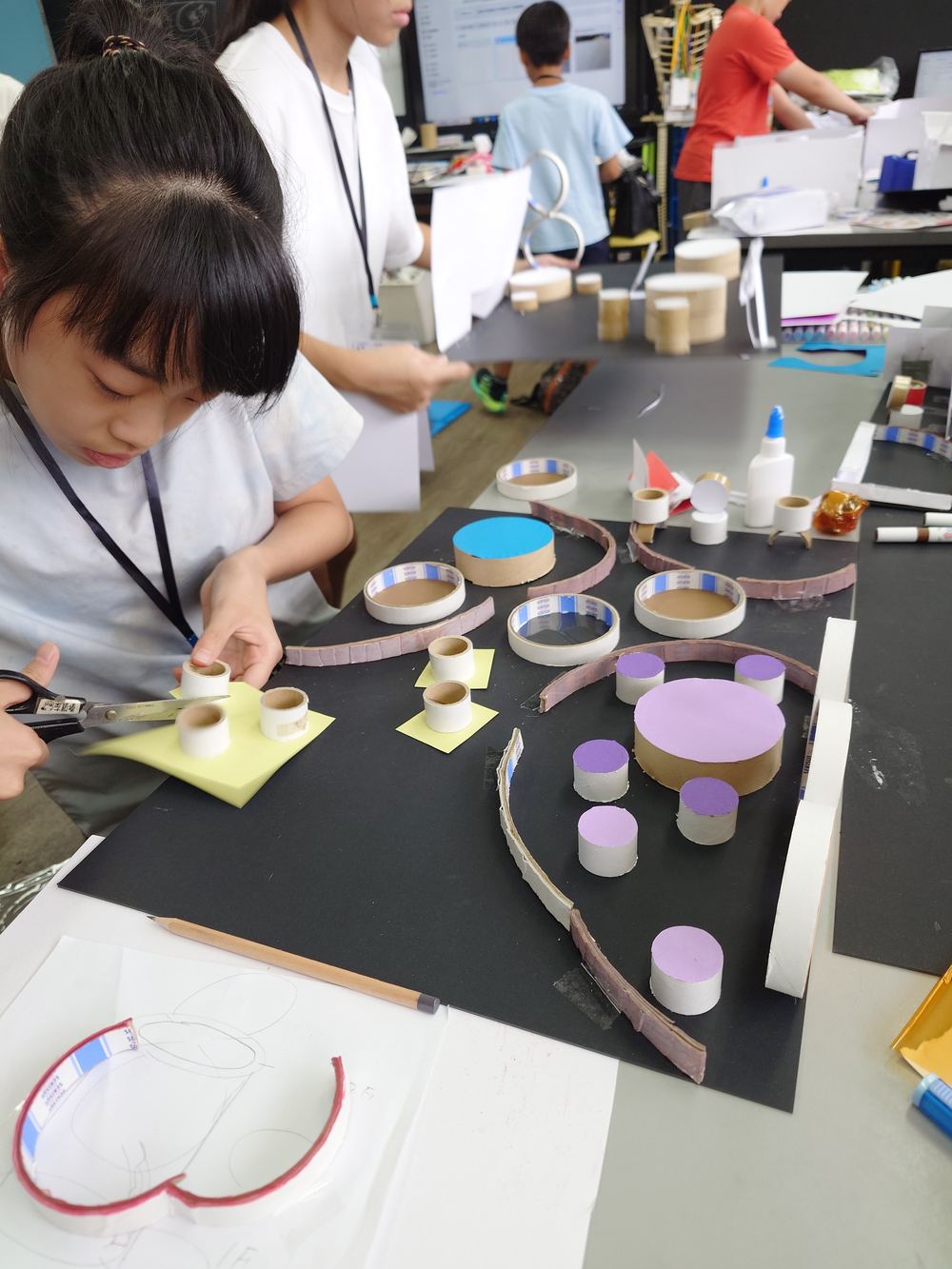
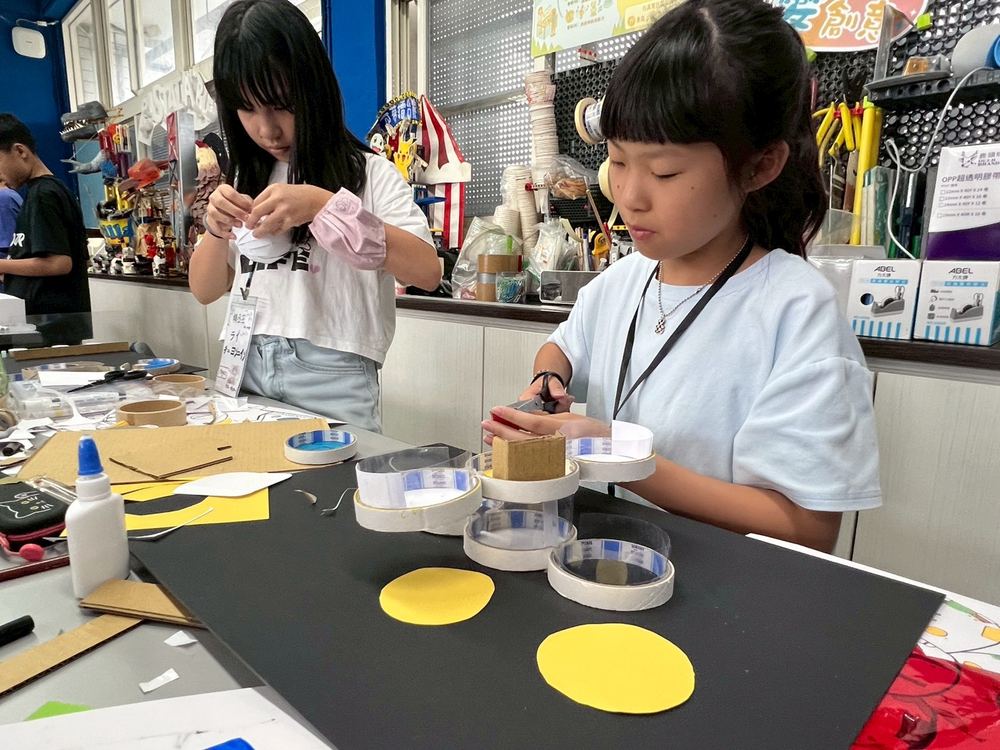
One goal: “build our own school library.” One constraint: “you must use a tape core.” Because the core is a circle, no model came out a square box.
From plan to solid—and here, a wall of structure appeared. A child who had barely spoken on the first day came to call me over when their dome roof began to sag. “The roof is collapsing.” I gave the technical support of reinforcing it, but showed several ways and left the choosing to the child: “My advice, the teacher's advice, your own idea—whichever you take, as long as the structure holds.” After that, the child began to ask questions, one after another.
The only constraint is the tape core (a circle).The answers to “which activity absorbed you most” scattered across the children. It was the program as a whole that drew them in.
PATH 6 | July 3 · The presentations
To tell
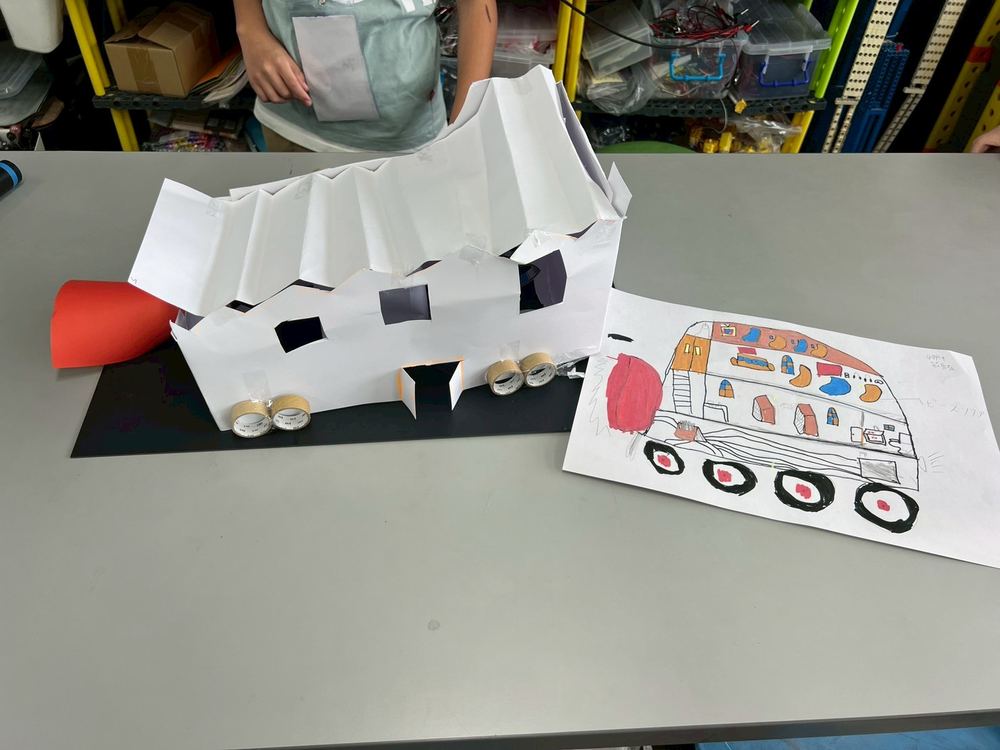
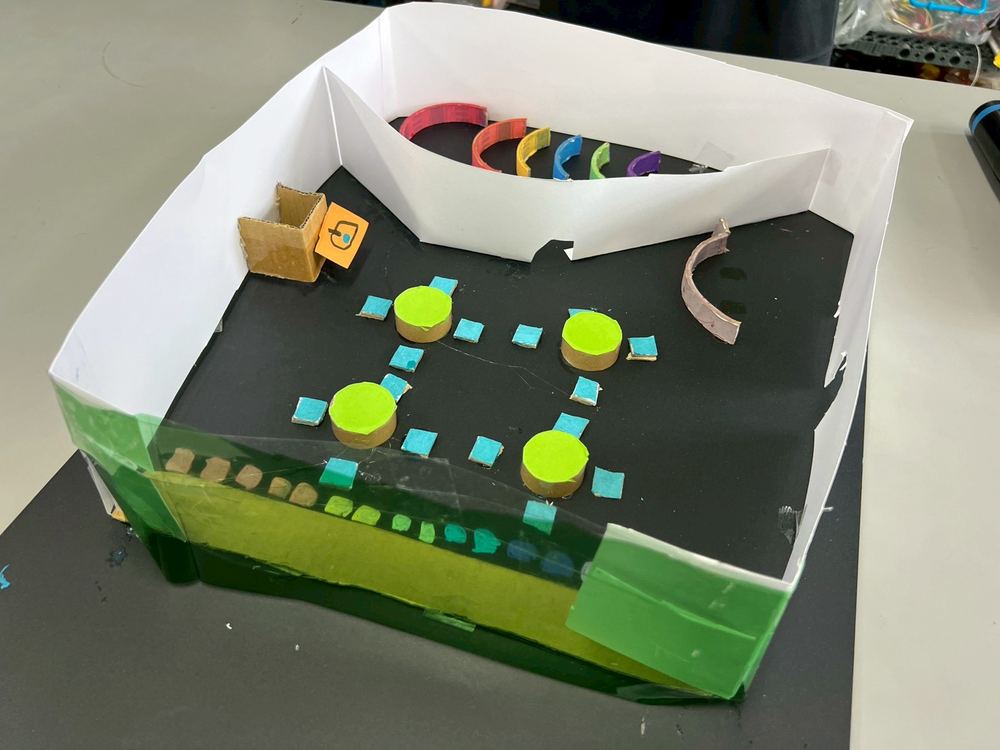
A flower library. A heart-shaped library. A library inside a fountain. A library of chairs. A library for aliens. And “a library where you don't read”—a space not for reading, but for doing what you want to do. That was the work of a child who, on the first day, had drawn “a house of math and Go,” and who, on the last, redefined the very meaning of the assignment for themselves.
When I asked a child who had painted only the glass surface green, they said, “Because there's a forest beyond it.” Without anyone telling them, they had applied Toyo Ito's design idea, observed the day before, to their own work. What can't be fully told in words, the work tells. And a child who had spoken very little on the first day presented on their own that day, and layered questions and comments onto the others' presentations.
“A library that runs.” The tape cores became the tires. From drawing to model—what you think of takes form.Rainbow arches for shelves. One child's answer: to sort the shelves by color.
THE LAST QUESTION
To close the presentations, I asked everyone: “If you could read a book in the library you built today—would it be fun? Would you be happy?” All sixteen nodded, big.
PATH 7 | What remained afterward
It got through
Somehow, it got through!
A survey option for “what did you do when words didn't work?”—four children chose this one
When words didn't work, the children used, on average, about three means of their own—the translator, gestures, drawings, asking friends. Among them, four chose “somehow, it got through!”—the experience of being understood without being aware of the method—and the full report keeps this as one of its most mysterious, most treasured records.
After the program, most of the thirteen children who answered the survey wrote that they “want to design and build something of my own again.” “I've started looking at buildings and rooms when I walk,” “I like libraries and books even more,” “I've become interested in Japan and Japanese”—each chosen by more than 70% of them. Not one child answered that “nothing changed.”
A VOICE FROM HOME“Hurry up and call on me—I want to present”
A child who spoke little on the first day, by the last, added questions and comments to others' presentations on top of their own. At home, the guardian recorded, independently of me, that “the nervousness about speaking turned into ‘hurry up and call on me, I want to present.’”
Source: my records + guardian survey (two independent sources agreeing)
My records
On-site primary records & memoirs Translation log, 364 utterances
Home observation
11 guardian surveys Reports of natural change at home
The Taiwan teacher
Written independently by Jason A chapter from the host side
each recorded independently
▼
The same change, described separately
Only what they agreed on is written as “confirmed”
Three “windows” of observation. Three parties—different roles, different places—had each written down the same change in the same child. This is the core of the report's reliability.
The learning didn't end in three days. A child who reproduced, item by item and accurately, my on-site explanation at home—“the library is by Toyo Ito; the holes in the wall keep birds from hitting it; grass on the roof, natural light to save energy.” A child who found an architecture book at a museum on the weekend and reported, “it's just like class.” A child who listed, by proper name, the sites seen in Japan three months earlier—“the ship gymnasium,” “Minamidera”—and spoke of their own learning in the vocabulary of design, “I learned plans, sections, three-dimensional forms.” Two children began mixing Japanese into their speech, and one wrote a thank-you in Japanese, on their own.
THE DESIGN
Confirmed from both sides
So that “architecture can cross language” would not end as a passing notion, the project was designed as two exchanges with the roles reversed.
APRIL 2026 | IN JAPAN
Kagawa & Naoshima
ON THE “CAN'T-READ” SIDE
The Taiwanese children (who can't read Japanese)
PARTICIPANTS
6 children from Taiwan + 9 from Japan
⇄
only the roles were swapped
JULY 2026 | IN TAIWAN
Zhonggang Elem. & NTU
ON THE “CAN'T-READ” SIDE
Me (Japanese instructor, who can't read Chinese)
PARTICIPANTS
16 children from Taiwan
Both countries' children take a turn on the “side that can't understand the words.” That symmetry dissolves the imbalance of host and guest, and makes both equal learners. In July, two children who had come to Japan in April turned into the “teaching side,” interpreting the picture book.
PRINCIPLES
Five principles behind the encounter
1
One goal, one constraint
The goal is one: “build our own school library.” The constraint is one: “you must use a tape core.” Every other decision is left to the children.
The more you instruct, the more the child fits inside the instruction. So—one goal, one constraint.
2
Answer with a question—give no answers
Meet a question not with the correct answer, but with “what do you think?” Sometimes carry it over as homework.
Many questions came up, but I answered not a single one.
3
Measure with the body
Before tools, measure with fingers, arms, height. From there, widen out to shelves, chairs, windows, doors.
Turning feeling into numbers, and numbers back into feeling.
4
Start from imagination
On the last day, tablets were deliberately cut off. Draw from memory, from imagination, from thought.
I don't want to pull ideas out of the internet—I want to pull them out of the imagination.
5
Assessment that doesn't rank
No ranking, no better-or-worse. Look at each child through six lenses: change, absorption, deepening, choice, engagement, gaze.
Don't worry about anything—just make what you want to make.
HONEST RECORDS
The things that didn't go well, too
What the full report holds most dear is not the successes, but the record of how difficulties were met. From five cases, each yields a principle.
CASE 1The dome roof sagged
I didn't fix it for them; I offered several ways to reinforce it and left the choice to the child. “My advice, the teacher's advice, your own idea—whichever, as long as the structure holds.”
Principle: what harms agency isn't whether support is given, but where the right to choose sits within it.
CASE 2“How will my work be graded?”
Even with a no-grading policy, a child grew anxious, assuming grading. My one word didn't reach; only when Winnie repeated it in their mother tongue could they turn to making.
Principle: “we don't grade” doesn't sink in with one declaration. Make the message travel by more than one path.
CASE 3There were quiet children
I didn't force speech. Through activities that need no talking—name tags, the picture book, measuring—I let engagement by pointing and nodding form first. Presenting came on day three, in the child's own time.
Principle: the first form of participation may be an act, not a word.
CASE 4They lean on the tablet
“Draw from memory” turned into image searches for many. After some thought, I cut it off on day three—adding a reason—and changed the next day's design based on what I'd observed.
Principle: “be free” alone lets children fall back, unaware, on old habits. Don't hesitate to redesign mid-practice.
CASE 5Translate it all, and the child just waits
The teachers who interpreted kept choosing between “translate now” and “deliberately leave it.” They didn't translate my questions right away, securing time for the child to grasp it themselves.
Principle: the interpreter is not a transparent converter, but a collaborator who carries pedagogical judgment.
FROM TAIWAN
The view from the Taiwan side
Jason (Wang Chai-Hsien), a teacher at the host school, wrote a chapter about this practice independently. It rests on none of my records—an assessment from outside (collected in full in Part 7 of the report).
When a teacher has the courage to step back, the child, for the first time, gets the chance to step forward.
From Jason Wang, “The View from the Taiwan Side”
What Jason wrote in this chapter was that, in Taiwan's classrooms, teachers—worried the children won't manage—tend to prepare examples and lay out the steps in fine detail; that this raises the completion rate, but can also narrow the room for children to think and choose. Having set down that candid reflection on their own practice, he wrote this for us: that from now on, in Taiwan's classrooms, he wants to reduce over-demonstration and answers given too soon, and give students more time to observe, try, fail, revise, and choose.
And on the change over three days: “What moved us most was not that sixteen distinctive models were completed, but that we witnessed their attitude toward learning beginning to change.” Learning that truly matters, he concludes, is not what was memorized, but “whether, after the program ends, the way that child sees the world has changed.”
“This is not one instructor coming to a school to give a lesson. It is an educational collaboration—many designing together, adjusting on the spot, learning from one another.” (Jason Wang)
FROM THE RECORD OF COLLABORATION
When the Japanese translation of this chapter arrived, my hand stopped, again and again, as I read. The doubt I'd carried before going to Taiwan—“is my way really all right?”—I feel I received its answer from these words. Dialogue worked in both directions—not only between me and the children, but between educators, too.
The full report doesn't erase the “felt words” born on-site; it places them beside the concepts of education—not a replacement, but a correspondence.
In later analysis, this practice showed features readable through sixteen lineages of theory, from Dewey (learning by experience) to Reggio Emilia (the image of the competent child). It also overlaps with ideas cultivated in Japan. The report's reading is this: it wasn't built by applying a particular theory—rather, eight years of trial and error had, on its own, arrived at the same conclusions as each of those theories.
And about the very condition of “words not getting through.” The practice of architecture is made of many modes—observing, pointing, measuring, drawing, building, gesturing—and each of them, just as it is, becomes a path for learning to travel. The wall of language worked not as an obstacle to overcome, but as a “just-right inconvenience” that drew out the children's own ingenuity. That, we believe, is why every guardian answered that not sharing a language was, in fact, a good experience.
CAN IT TRAVEL?
Can this be copied?
“Isn't that something only you could do?”—the full report doesn't flee this question. It breaks the factors of success into three.
Person-bound
Particular to me; takes time to acquire
An architect's expertise (instant checking of measurements, structural judgment)
Work with children since 2011, and ~8 years of architecture education since opening the studio in 2018
Training in dialogic art viewing
Structural
Can be written down and handed on (so we hypothesize)
The five principles
The backbone of the three-day plan
The “we don't grade” operating rule
Environmental
Substitutable with local resources
The host school's cooperation (interpreting, operations)
Guardians' consent and help
Access to real architecture (a school library will do)
Circumstantial evidence is gathering that the structural factors can work apart from me. Even before we met, Jason was independently practicing the same kind of approach—“hand them a map and let them walk it themselves.” And he transferred the thinking of the April newspaper dome, on his own, into an entirely different theme at his school (an education in kind speech). Still, a full reproduction by another teacher has not yet been tested. The report offers this not as proof, but as a hypothesis to be verified.
The limits, honestly. This record is a single case of sixteen children, with no control group; it cannot be generalized statistically. The surveys are from families who stayed to the end, and the answers may carry some deference to the practitioner. Long-term effects (six months, a year on) are yet to be verified.—And even so, the direction of change shown by ten independent sources was consistent.
WHAT'S NEXT
What comes next
A follow-up study at six months and a year. Continuing the mutual visits of Taiwanese and Japanese children. Building a curriculum framework that even teachers without an architecture background can use. A project where children take part in redesigning school spaces. And to grow “children's education and development through architecture”—a field that joins architecture to pedagogy and developmental psychology—together, from Taiwan and Japan.
Jason's chapter closes like this: “In the end, architecture education is not only about architecture. It is a guide—so that children learn to observe the world, learn to understand others, and come to believe that they, too, have the power to take part in creating the living environment of the future.”
The three who made these three days. This collaboration was never a matter of one side teaching the other.
Everything on this page draws on Space Inquiry Camp, Starting from the Library—Taiwan × Japan Children's Architecture Education Program, Comprehensive Practice Report (August 2026, 32 chapters). Children's names are anonymized, and photographs are published within the range consented to by their guardians. The quotation from “The View from the Taiwan Side” is used with the permission of its author, Jason Wang. Please get in touch before reproducing or redistributing this page.
MIRAI CRAFT
Space Inquiry Camp, Starting from the Library (July 2026, Taiwan)
Record & text: Mutsumi Nakahira (née Nogami) / MIRAI CRAFT Architectural Design Office
Taiwan co-practitioners: Jason Wang & Winnie Tseng (New Taipei Municipal Zhonggang Elementary School) | August 2026